The high, eerie hum of the postman’s electric van.
A woman receives her supermarket delivery, then runs out of her front door – a bottle of lemonade has been pierced and is spraying everywhere. She waves it like a Grand Prix winner.
Men with covered faces and smiling eyes straddle a half-built extension, brave the dust their tools generate.
Pavementside trees begin to blossom.
A dog stands outside a bakery patiently while their owner ducks his head in for a morning cake.
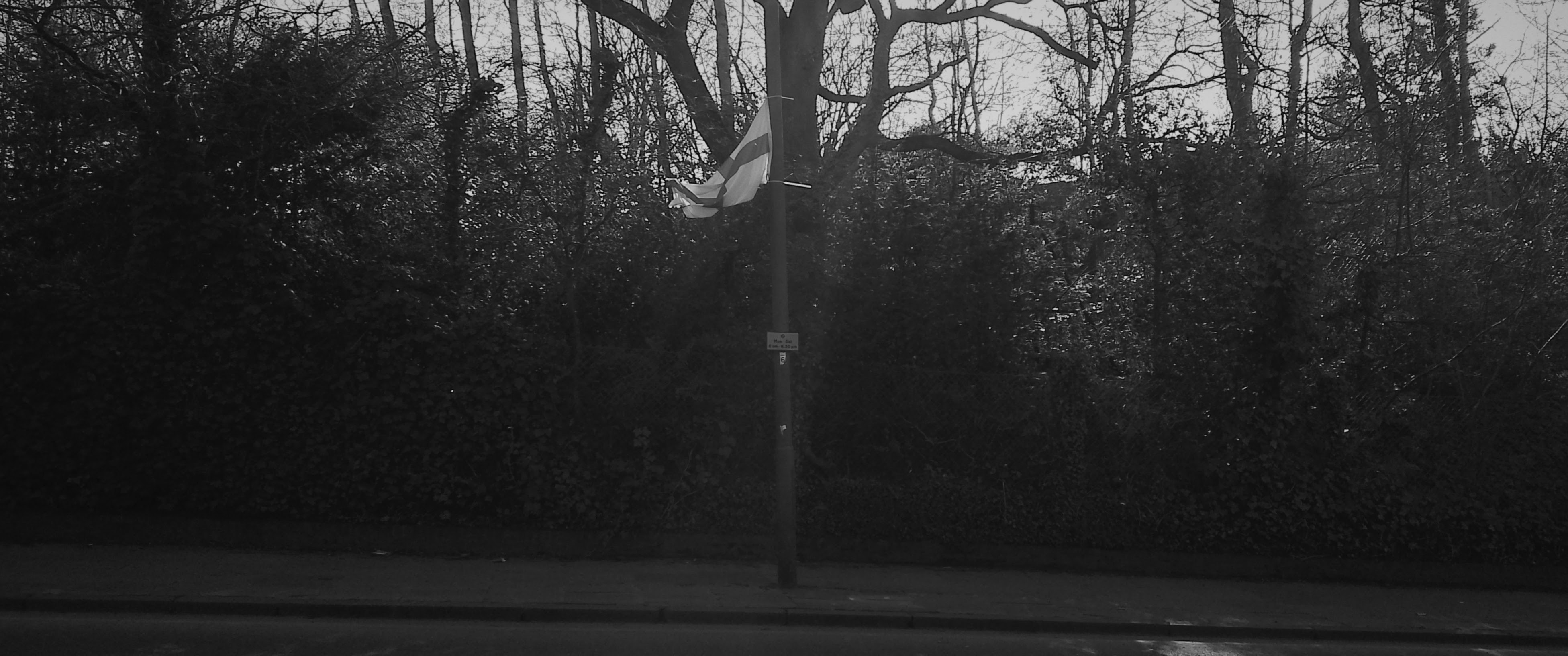
A greying, tawdry flag hangs half-mast from a lamppost, is caught in the reaching branches of a nearby tree.
God, it’s rained a lot lately. Day after day of the stuff from the start of the year, relentless precipitation, the only variety in weather being whether you’ll get drizzle, a shower or a downpour.
And yet, the dog still needs walking. And one night we headed out for a walk and the heavens opened and we were all soaked and we were very grateful for the dog dragging us obligingly into the nearest pub. She’s a well-trained pub dog.
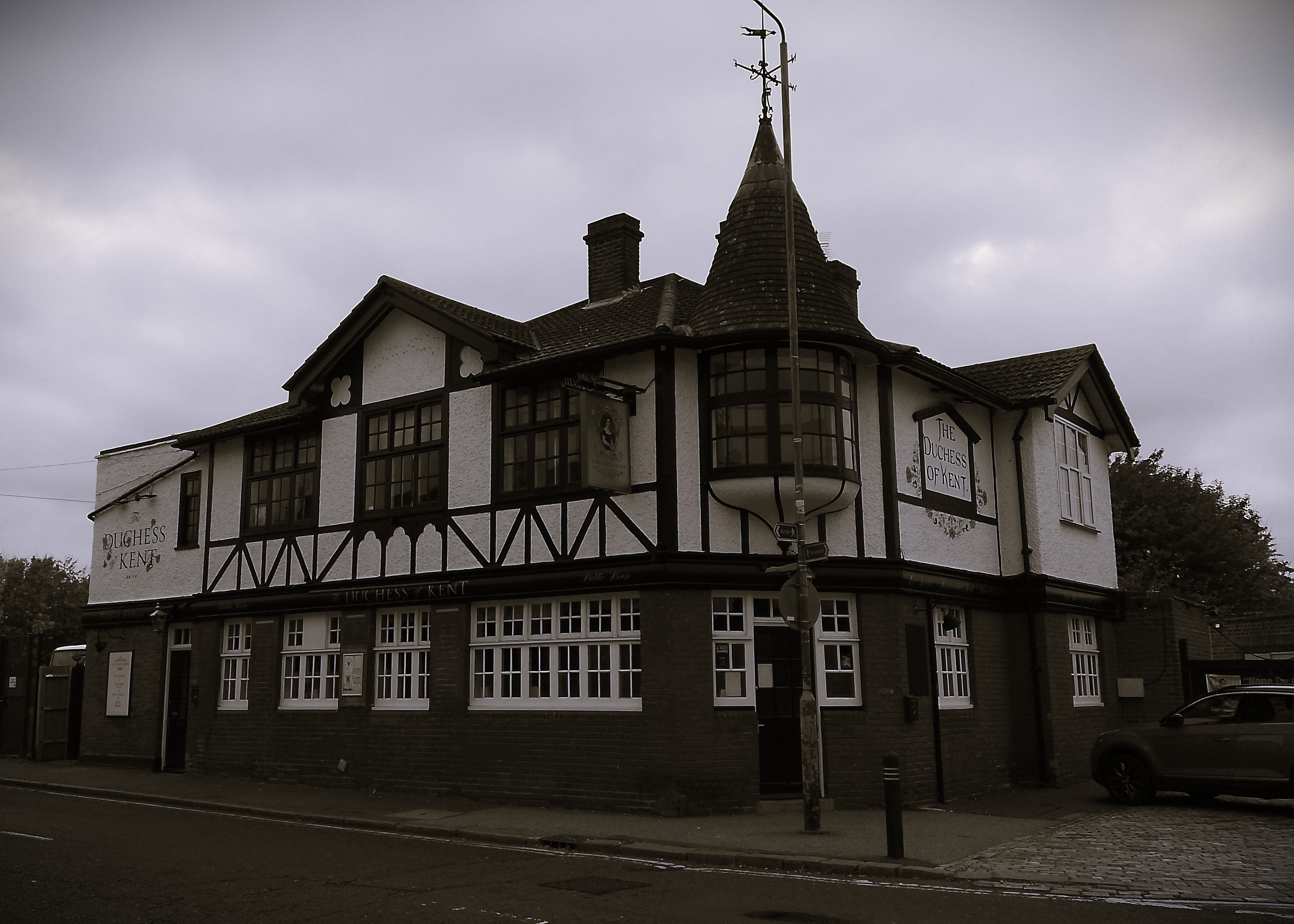
The Duchess of Kent has always felt very much like a local’s pub. It’s not quite a backstreet pub, but it is pretty tucked away and surrounded by residential streets, a park across the road, a school next door. It is rather handsome on the outside, a corner pub that looks like a cross between a cottage and a castle, a mix of mock tudor and red brick with a conical roofed turret as its centrepiece. We haven’t used it often but it’s always been fine, by no means a destination pub, but certainly a pretty fair option when you’re wet through.
We got the most lovely welcome. The landlady recognised us from the odd visit. She offered to take our coats out to the back to dry them off properly. The dog’s coat was placed over the grill of a small open fire to dry too.
The landlady’s family and friends, who seemed to make up most of the clientele at the time, were shooed away from the fire so we could sit by it and warm up. For a moment it felt much more like being a guest in someone’s home than being a customer in a pub.
Once we’d dried out and thawed out a little we moved away from the fire, not wanting to hog it and increasingly aware that the dog wasn’t too sure about all the spitting sounds from the flames. We found a table in the corner, well placed to take everything in but not feel like we were in the way. The landlady brought over dog treats, told us the dog was welcome to sit on the banquette seat we were on. Her son came over and made a fuss of the dog too. This all pleased the dog very much. We enjoyed a drink and some crisps, packets torn and opened out on the table, as they should be.
A few other people popped in and sat at the bar, nursing their pints. The pool room seemed popular. A woman came in and had a drink while doing the crossword. I always think it is an encouraging sign when you’re in a pub and see women feel comfortable drinking alone in there. The football was on the telly, but more as background than as focus.
It was time to brave the rain again. Hopefully it had died down. We asked for our coats and they were in a much better state than when we came in. Wrestled the dog into her coat. And out into the world giving our thanks for the welcome, for the warmth. We stepped out. The rain wasn’t so bad now.
Sunday afternoon in The Old Tiger’s Head, Lee. It’s good to see a pub doing well when it has had its fair share of trials and tribulations – to go from boarded-up to thriving is quite an achievement, I think. It was sad seeing its counterpart across the road, The New Tiger’s Head no longer a pub, but at least the building hasn’t been completely left to rot. As an aside, I think more pubs should have matching names.
The place is very much a Sunday Lunch kind of pub. It seems like every table is having a roast dinner. The decor is modern and a bit trendy, but with an underlying pub-ness. It appears to be catering more for the monied folk up the road in Blackheath than the less well-heeled lot down the road in Lee. Everything is, well, keenly priced. The staff, on occasion, seemed harassed.
I could absolutely see why it is popular, but I also thought it wasn’t really my kind of pub.
A midweek lunch at the White Cross, North Cray. A country pub that one day woke up and found a massive dual carriageway was running past it. And as such, it’s not the easiest pub to get to unless you’re driving there.
Inside was all more modern than I was expecting from the look of the place outside and the age of the pub. At a small bar at the front sat a few drinkers, the locals/regulars by the look of it. As you walk around the bar to the back of the pub there’s two seated sections, one very much looking reserved for those having meals, but really the whole area seemed more for eating than drinking. Drinks were to be ordered from the bar. Food from a separate counter. So, you have patrons dancing between the two, and their table, trying to get through their order.
There were older couples, a few people who looked like they’d popped out from work, at one table a big family birthday party.
Clearly the food is what brings people in, and a busy pub on a weekday afternoon is another achievement in this day and age. The staff seemed a bit harassed too.
Clearly food-led pubs can and do work. But I’m not sure they make for the most relaxing places to go. The staff are having to juggle food and drink orders, along with whatever other demands coming from patrons often with very different needs – it’s hard enough serving drinks quickly let alone fielding questions about the menu, asking about allergies or dealing with special requests to change what will be on someone’s plate.
And there can be a bit of an off-vibe too. People in for a pint create a different atmosphere to a big family having a meal. Either can be annoying, and in the same place that annoyance can multiply – either with each other, or with the staff, or from the staff to the customers. Too many things for too many people makes nobody happy.
However, if food helps keep pubs alive I’m all for it. And there’s certainly times when it’s nice to head out for a meal but you want something less formal than a restaurant but with a little more service than a fast food place. But I don’t think it is easy to find places that get both food and drink right – it takes two quite distinct skillsets to strike the right balance and create the best possible environment for everyone to enjoy. A great pub that does food and drink right, with an atmosphere that appeals to all, feels a bit like a unicorn.
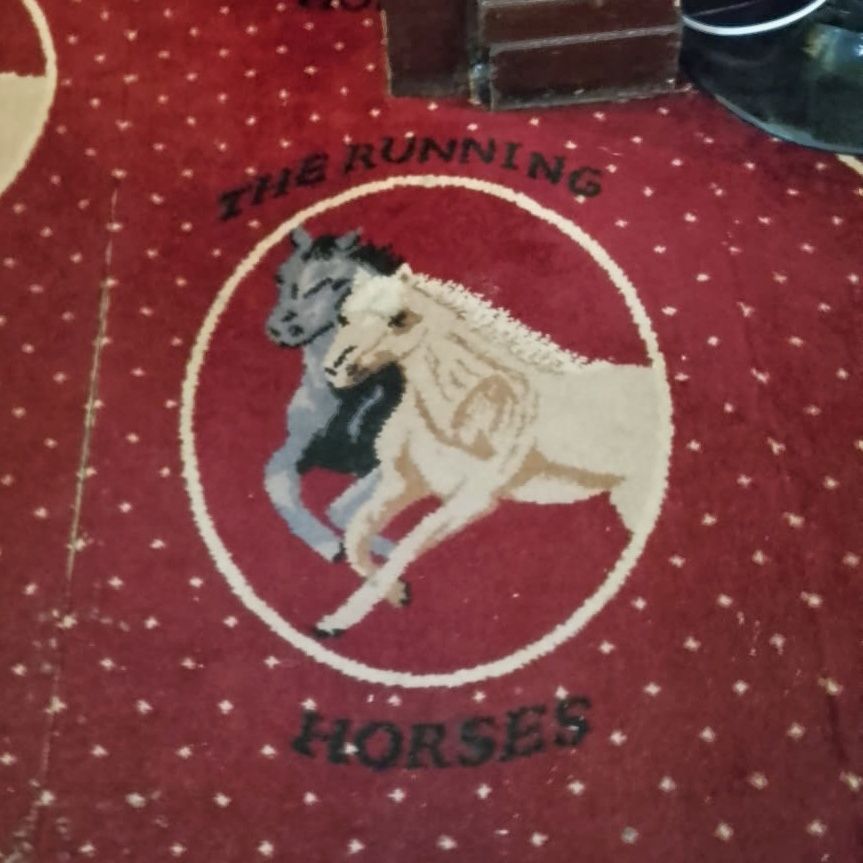
A very swift half in the Running Horses, Erith. If you were to flick through local history books you would see that Erith once had many pubs in its town centre. Now it only has one. The Running Horses is a rather large and rather handsome 1930s building, overlooking the Thames. The Saloon bar is lovely, with what looks to be the original features, but is generally closed. The public bar is a fair bit more lived in, a reflection perhaps of it taking all the passing pub traffic alone.
I like a pub with a bit of history and a bit of a mythology. Places with a tale to tell, and a tale you can tell yourself when they are mentioned. There’s apparently been a pub on this spot for over 200 years. After its rebuild in the 1930s it was bombed in 1940 – killing the licensee Zachariah William Coles, an ancestor of comedian and Celebrity Traitors winner Alan Carr. There are tales of many years ago the upstairs holding a party and the floor collapsing onto the drinkers below. If you were to mention the pub to anyone local of a certain age they will more than likely tell you all about how popular the pub’s carvery was in the 70s and 80s, how it was the place everyone went on a Sunday afternoon.
The carvery appears to be back, although it doesn’t seem to be as popular as it once was. There are a few people having a drink waiting for it to open. A few others are playing pool. The Winter Olympics is on the telly. We don’t stay long, but there’s a lot to be said for pubs in town centres, where you not only grab a drink but rest your legs, use the loo, escape the shops for a bit. Pubs can, and perhaps should, be a refuge. And when they are they weave themselves into the fabric of the community. They don’t have to be a destination, just a stopping point on the way.
All of this made me think that sometimes we underappreciate pubs as pitstops. They don’t always have to be destinations in and of themselves. We don’t always need to settle in for a session. Sometimes pubs work best as somewhere for a brief reprieve from the outside world before you pop on your coat and brave the big bad world again.
Boak and Bailey wrote recently about honesty in writing about pubs and beer. It is for Patreon subscribers only, but it is well worth subscribing to them if you have any interest at all in the subject matter. I won’t quote from it, as it is behind a paywall and that doesn’t seem fair, but I will say it gave me plenty to think about – not just in terms of writing about pubs and beer, but in writing about anything.
I think all writing needs to be honest on some kind of fundamental and foundational level. Even fiction. If there isn’t some kind of capital-T Truth to writing then what is the point? It just becomes something empty, an attempt to please or a parlour game or just a means to some other end. Readers can sniff out inauthenticity, and if there is no honesty to the writing then the whole thing falls apart. I think this is one reason why AI writing is so unsatisfying, and basically offensive. There’s no humanity to it. It is just a Magic Guessing Machine giving you an approximation of what it has calculated you want to read. If nobody could be bothered to write it, I can’t be bothered to read it.
I believe that writing, or at least writing worth caring about, is a form of deep communication between writer and reader, a form of humanity in a world that often seems to lack it. Honesty is a key component in making that connection. Truly “bad” writing is when that attempt at connection is absent. Technically bad writing can still survive if there’s kind of humanity lurking underneath. I’d much rather read a failed attempt at Truth than technically perfect heartless prose.
However, when it comes to any form of criticism (be it of pubs and beer or music, books, theatre, sport) I think it gets a little more complex. Behind the pub or album or book is a human being, or several human beings, who were more likely than not trying their best. Where is the humanity in making them feel bad for their efforts? But then where is the honesty in only saying nice things?
I suppose this an ethical dilemma for anyone undertaking criticism, from the broadsheet book reviewer through to the person leaving a bad Google review about a restaurant. Is it fair to potentially put someone’s livelihood at risk, just because you didn’t like what they did? Should you demoralise someone and put them off their efforts just because they weren’t to your taste?
There is the risk of the writer just conducting an “Owl review”. I can’t find the original article on this, but it is the act of essentially criticising something for not doing what you want it to do, even if that wasn’t the intention of the originator. So, for example, criticising a book for not having enough owls when that was not something the author was setting out to do, just because you like owls. There’s definitely plenty of this in pub writing – most pub writers have a good idea of their Ideal and when a place doesn’t meet that Ideal it is easy to criticise it, even if the place is attempting to do something quite different.
It is fundamentally more difficult to write a negative review than a positive one. Enthusiasm is a great impetus to writing. Revenge might provide a similar thrust, but generally leads to less worthwhile results. If something is quote-unquote “bad” it needs a whole lot more context than explaining why something is quote-unquote “good”. Outside of reviewing just plain obviously terrible stuff or conducting a hatchet job, a reviewer needs to set out why something didn’t succeed, to be constructive, to illustrate their own viewpoint or if they can’t do that at least be entertaining rather than just dismissive.
This feels even more complicated with pubs. Often a review is only really seeing a snapshot of a place, how it happened to be at one moment in time. I know plenty of pubs that feel incredibly different depending on the time of day or day of the week, depending on who is working there that day and who is drinking there. I don’t think you can give a proper, full assessment of a pub unless you have got a feel for the ebb and flow of the place. Maybe you just caught it on a good day, or a bad one.
I suppose I have come a few conclusions on this. First, criticism is more valid (or if I’m being truly honest, perhaps just far easier) when you are punching up rather than punching down. Taking down a major writer or a popular band or a major pub company feels more constructive than taking down a self-published author, an obscure artist on Bandcamp or a local independent pub.
Second, any writer who is even considering these issues, who sees this as a dilemma rather than something to dismiss, is probably on the right track. We won’t always get it right, sometimes we should be negative and that might affect others, but at least in considering the consequences of our actions we will be attempting some kind of accountability and, well…honesty.
Finally, writing (especially criticism) is almost always just as much about the writer as the subject matter. In explaining what we like and dislike, and in how we go about that, we reveal just as much about ourselves at what we are praising, critiquing or condemning.
 Wait until next year